Debt Payoff Tracker: Snowball vs Avalanche, Side by Side
You have three or four debts at different rates. You pay every month, but you can't say when you'll be done or how much interest you'll pay before then. Every article tells you to pick "snowball" or "avalanche", and none of them shows you what each one costs with your numbers.
From: a pile of balances and minimums, and no payoff date.
To: a projected payoff date and total interest for both methods, from your own inputs.
Where this method comes from
The two orders this tracker compares connect to two lines of published research. Neither study tested this tracker, and neither tested snowball against avalanche head to head:
- Closing accounts and finishing. In records from a debt settlement firm, people who closed more of their accounts were more likely to eliminate their debt, whatever the dollar size of the accounts they closed. This is a link found in the records; it doesn't show that closing accounts caused people to finish. Gal & McShane (2012), Journal of Marketing Research 49(4), doi.org/10.1509/jmr.11.0272. Snowball (smallest balance first) closes accounts early.
- Interest and order. Paying the highest rate first is the order that costs the least interest, under the usual assumptions. In four lab experiments using a debt game, participants still tended to pay small debts first, even when larger debts carried higher rates. Drawing their attention to the interest each debt had built up helped them reduce their total debt faster. Amar, Ariely, Ayal, Cryder & Rick (2011), Journal of Marketing Research 48(SPL), doi.org/10.1509/jmkr.48.spl.s38. Avalanche (highest rate first) puts the interest up front.
This tracker doesn't pick for you. It shows both projections, and the interest each one costs, side by side, so you can see the trade-off with your own numbers.
What setup involves
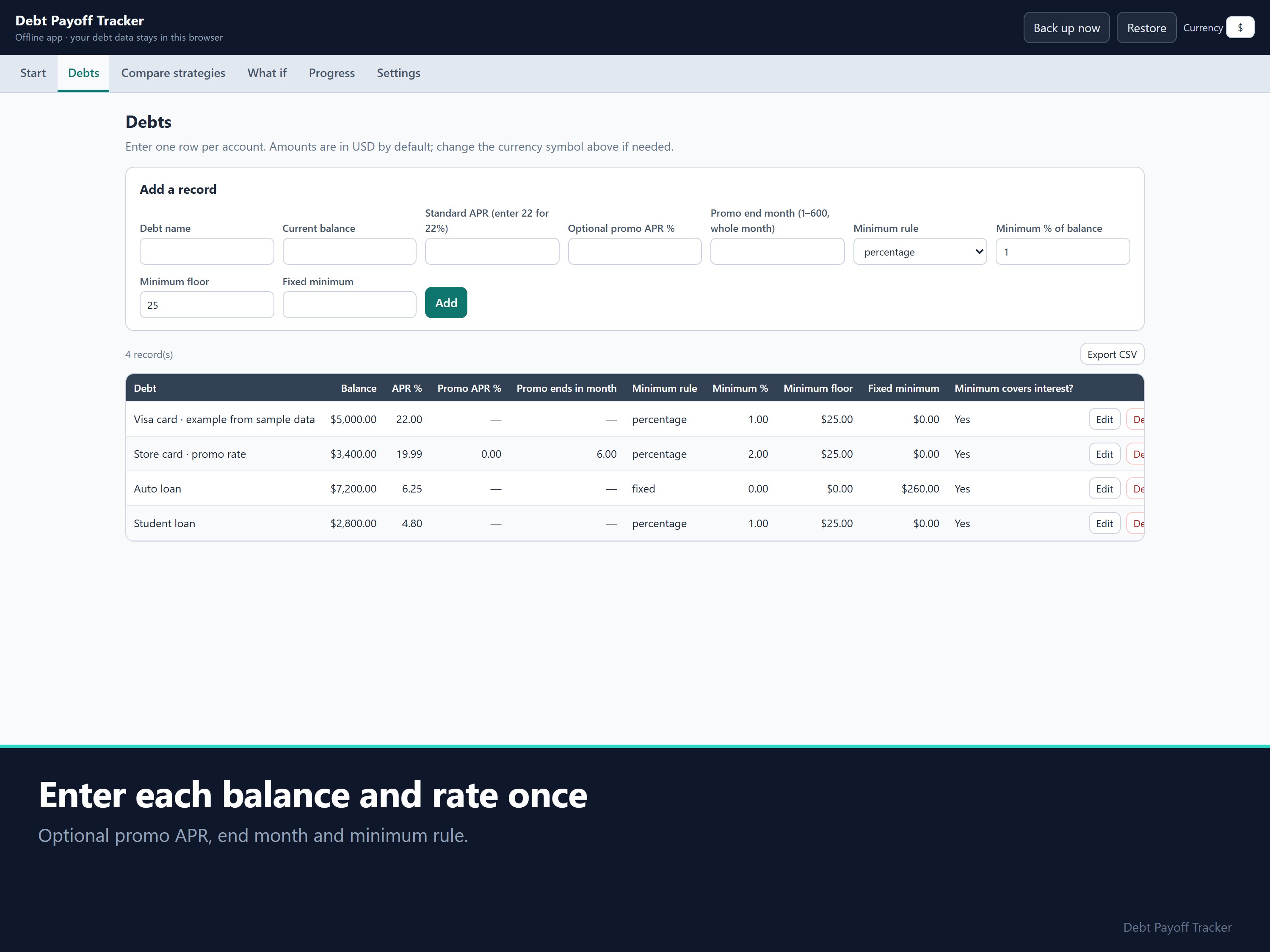
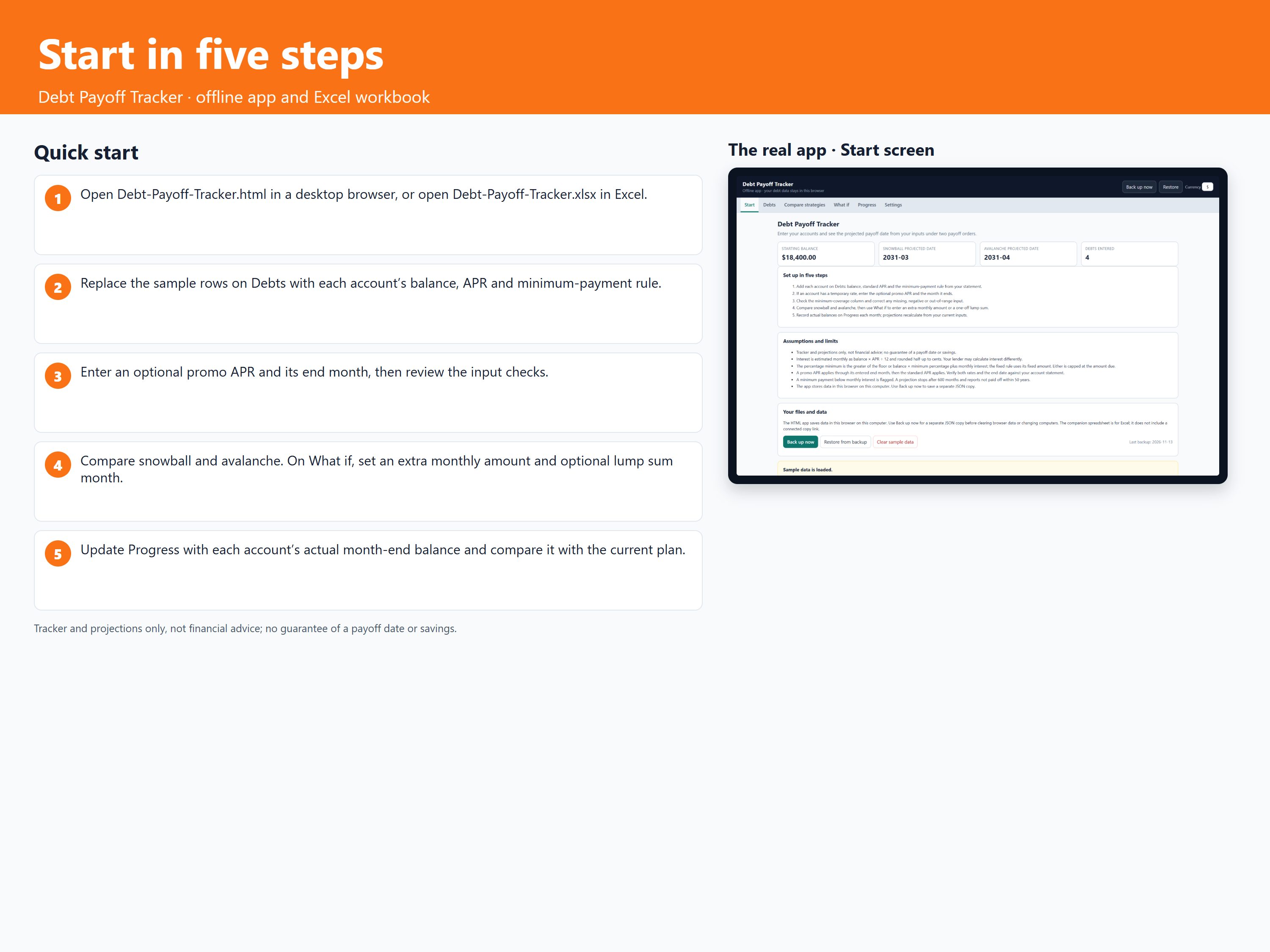
- Five setup steps, walked through in the quick-start PDF. You enter each debt once, then view the projections.
- No formulas to write. You type balances, APRs and minimums. The app and the workbook do the arithmetic, and the workbook's formulas stay visible.
- Works offline. No account, no login, no subscription. Your debt data stays in your browser on your computer.
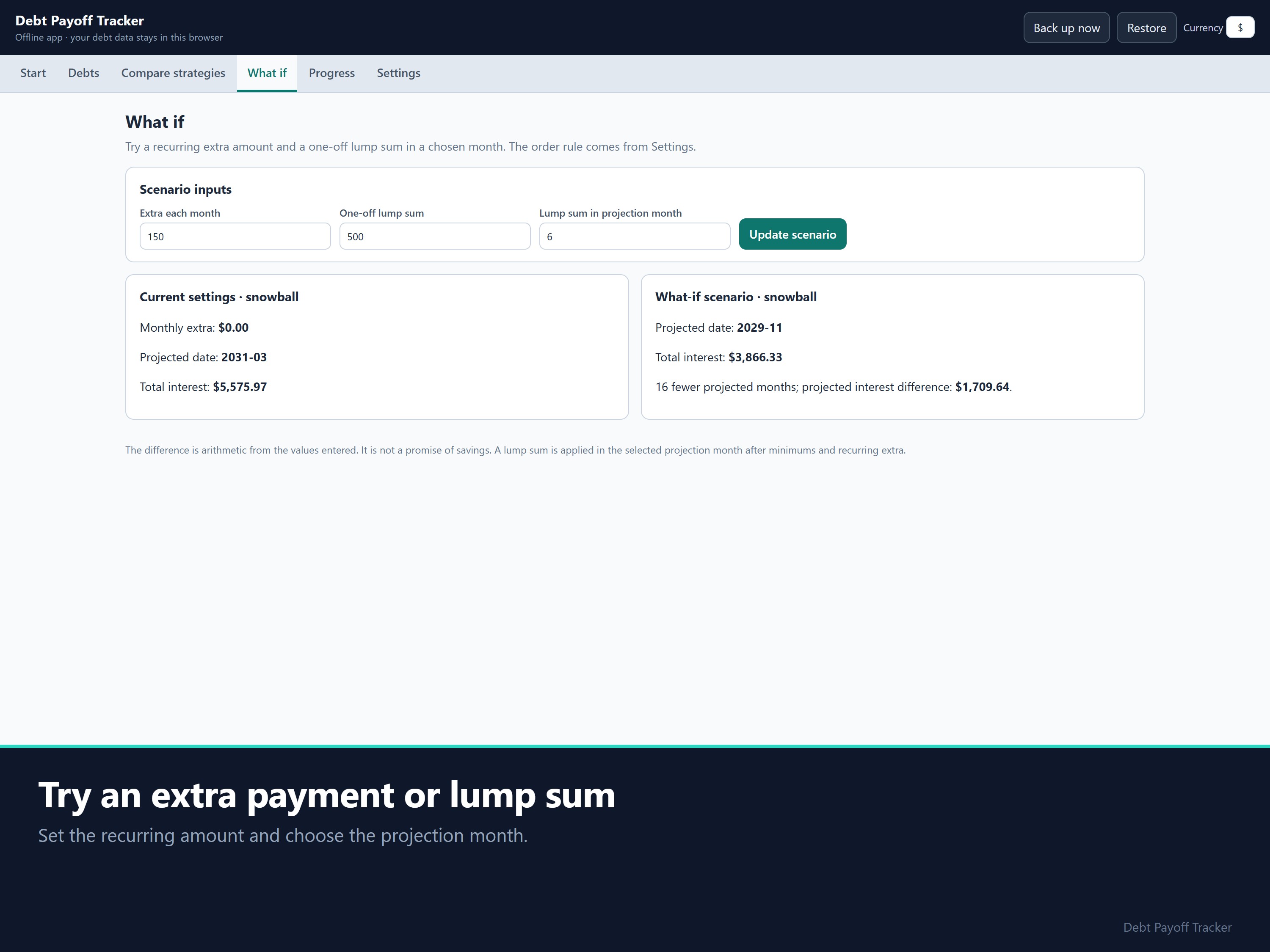
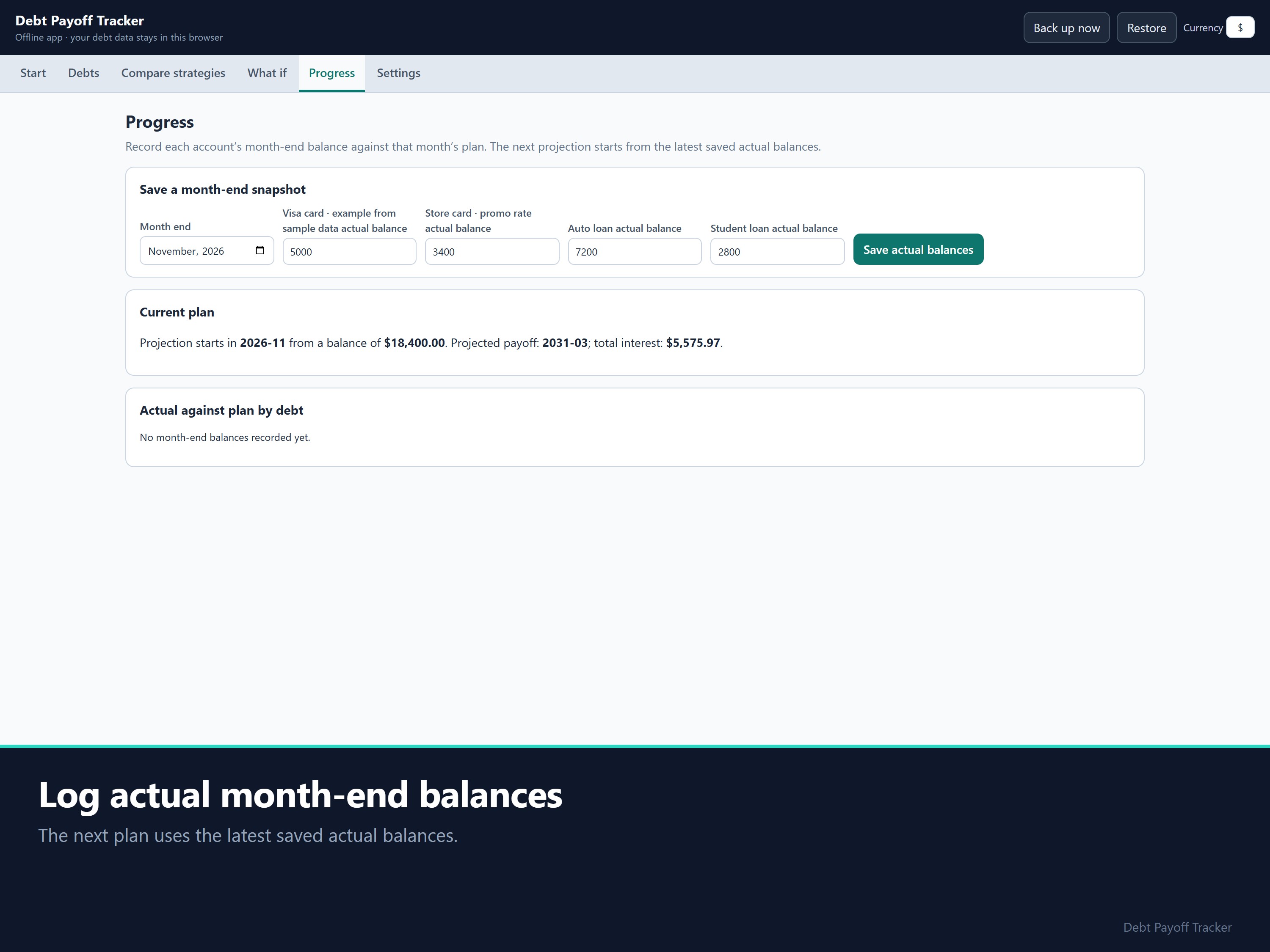
- Enter each debt once, and you get the snowball projection, the avalanche projection, a what-if (an extra amount each month or a one-off lump sum) and a progress log.
Worked example
With the sample debts loaded in the app:
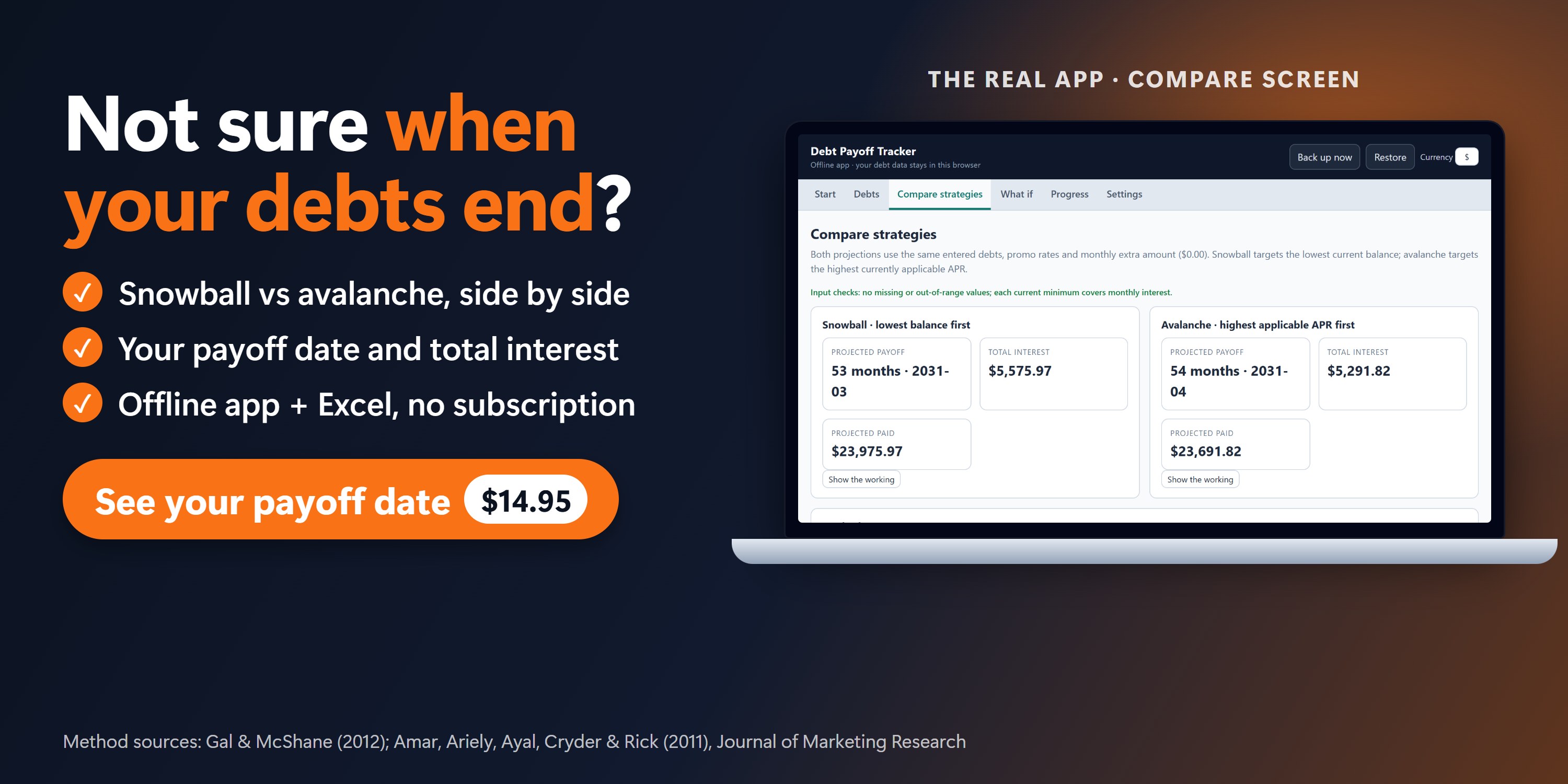
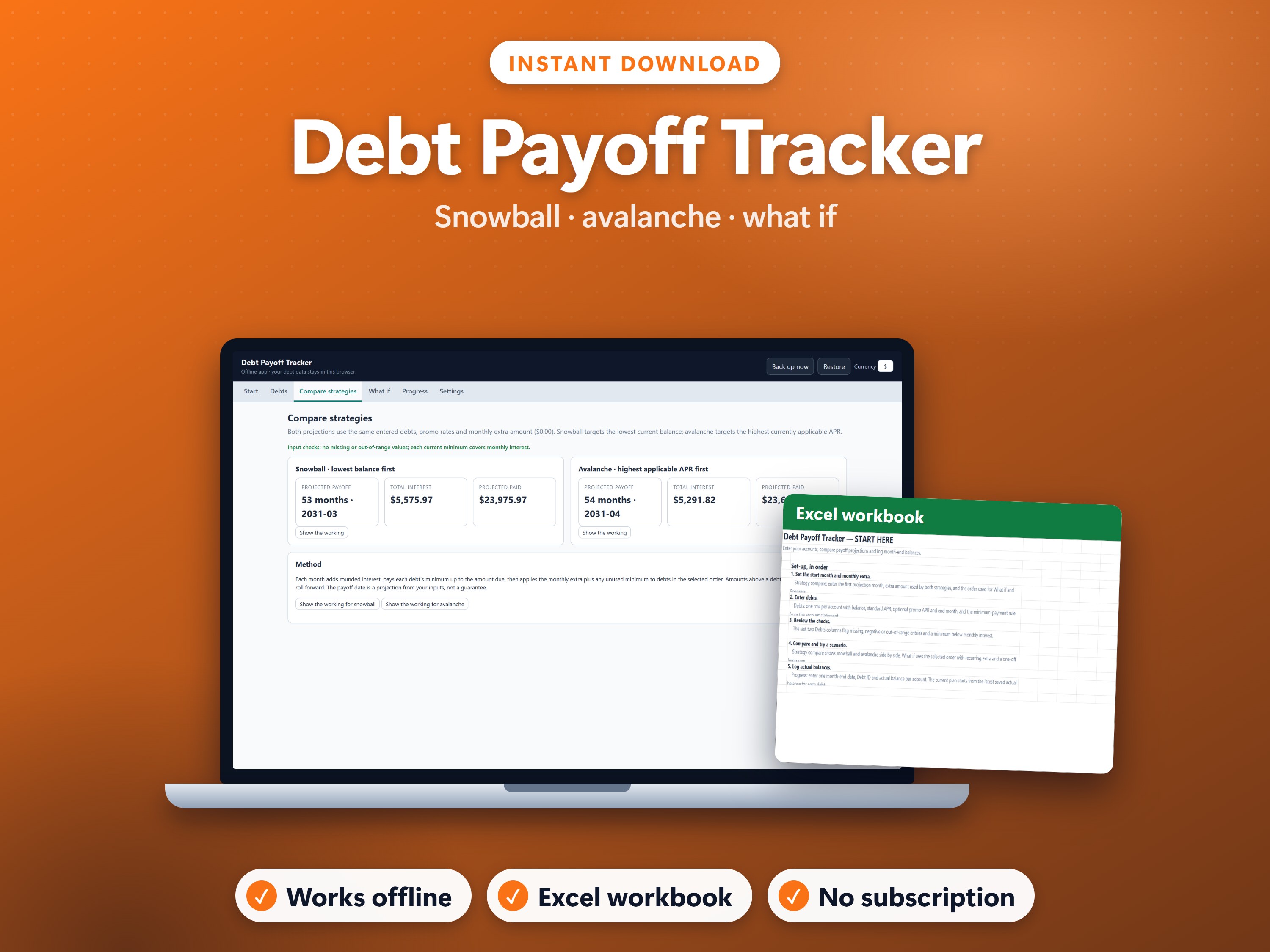
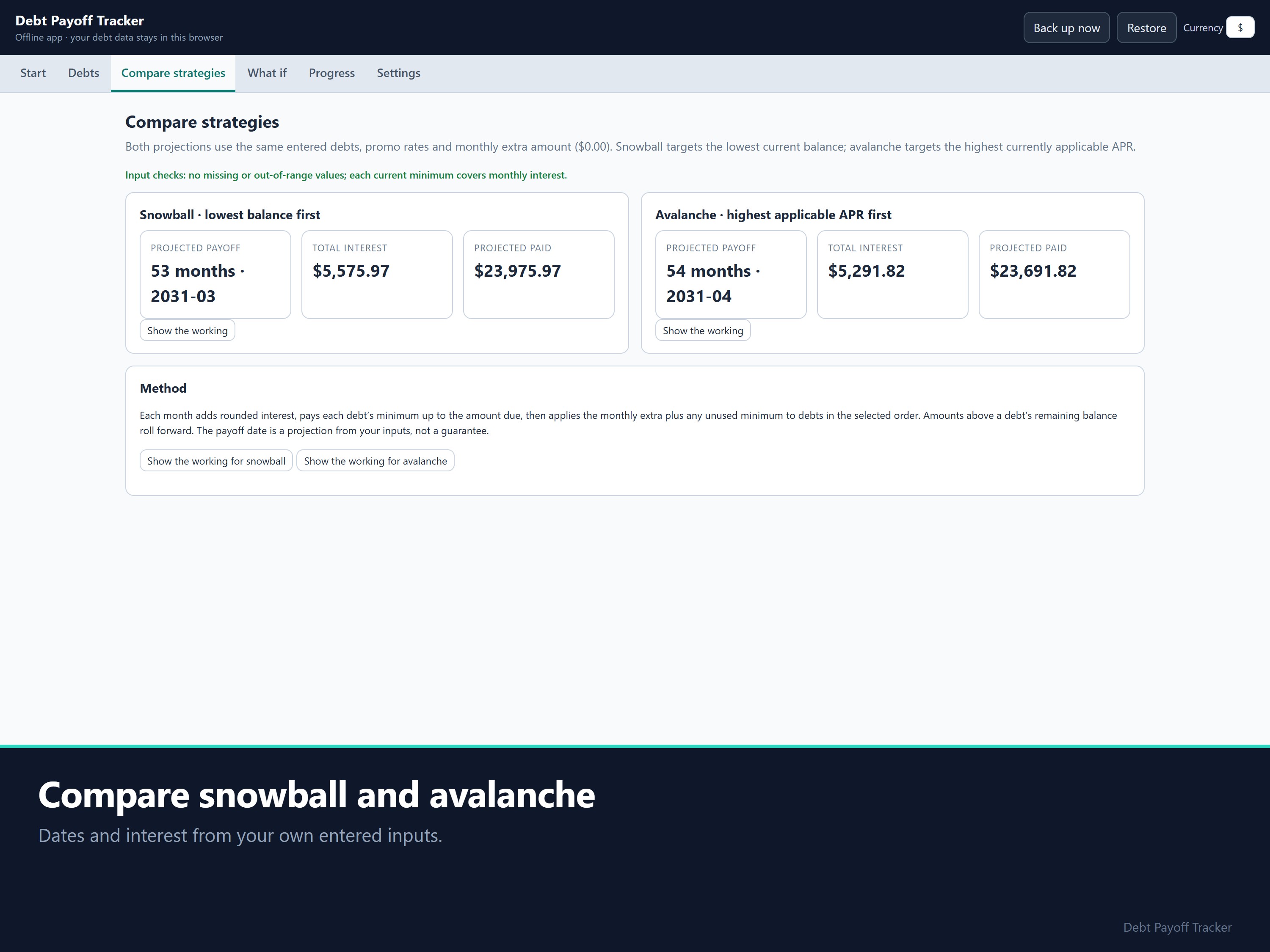
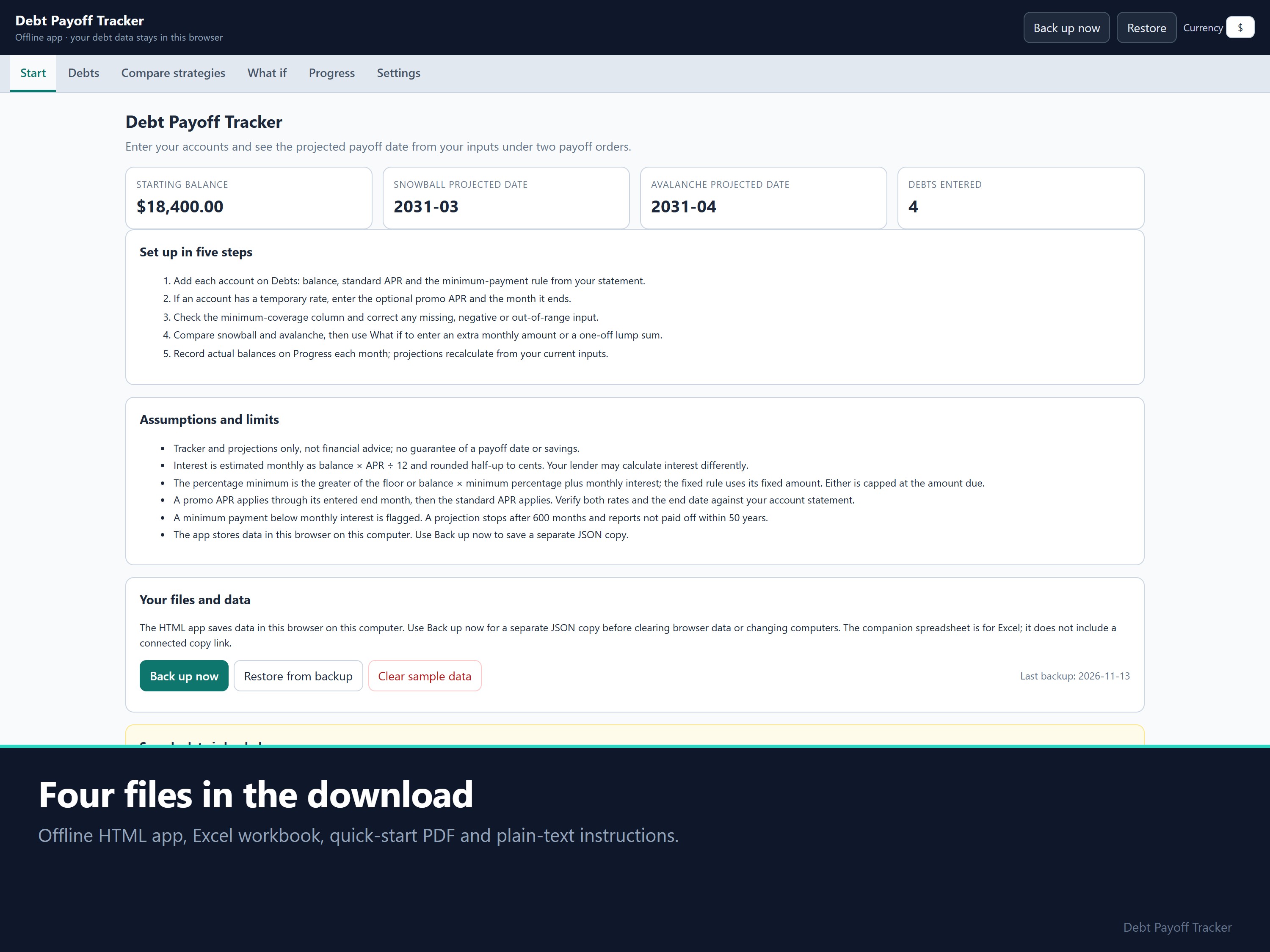
- Snowball: paid off in 53 months, with $5,575.97 total interest.
- Avalanche: paid off in 54 months, with $5,291.82 total interest.
On these sample inputs, avalanche costs $284.15 less interest and finishes one month later. The Excel workbook and a separate calculation gave the same figures. Results depend on the assumptions below, and your numbers will differ.
Check one case by hand: a single $1,000 debt at 12% APR accrues $10.00 of interest in the first month ($1,000 × 12% ÷ 12).
How the numbers work
Interest is estimated monthly as balance × APR ÷ 12, rounded to cents. A promo APR applies through its end month, then the standard APR. Snowball targets the lowest balance; avalanche targets the highest current APR. Minimums are paid first, and a freed minimum rolls into the next target. Your lender may calculate interest, minimums or timing differently.
FAQ
- Is this financial advice? No. It's a tracker and projection tool. It gives no guarantee of a payoff date or savings.
- Do I need Excel? For the workbook, yes. The app is a single HTML file for a desktop browser. It was tested in Chromium (the engine behind Chrome and Edge); other browsers are untested.
- Does it work on a phone? It's built for a desktop browser and isn't tested on phones.
- Where is my data stored? In your browser on your computer. Use "Back up now" to save a copy.
14-day money-back: if it isn't right for you, email support@dokimos.my within 14 days of purchase for a full refund. Questions: support@dokimos.my, answered within one working day.
How this was made: built with the help of AI tools, to my design. The method sources above are published research. AI did not write them.
Tracker and projections only, not financial advice. No guarantee of a payoff date or savings.


Dokimos
Hi, I'm Benjamin, based in Malaysia. I build pricing, profit and bookkeeping spreadsheets for one-person businesses: makers, service providers, landlords and online sellers.
You pay once and own the files. Most products come with an Excel workbook, a Google Sheets copy and an offline app that runs in your browser. Every formula is visible, so you can check any number yourself.
This store is new, so there are no reviews yet. If something doesn't work as described, email me and I'll fix it. I reply within 1 business day (Malaysia time, GMT+8).
What You'll Get:
- Debt-Payoff-Tracker.html: one offline app for a desktop browser, with six screens: Start, Debts, Compare strategies, What if, Progress, Settings.
- Debt-Payoff-Tracker.xlsx: an Excel workbook with the tabs Start Here, Debts, Strategy compare, What if and Progress. It has 20 debt rows and 600 projection months. It is for Excel; no Google Sheets copy is included.
- quick-start.pdf: the five setup steps.
- HOW-TO-USE.txt: instructions, assumptions and backup notes.
All four come in one zip file (Debt-Payoff-Tracker.zip, about 10 MB).
- 1 Files
-
Debt-Payoff-Tracker.zip
10.0 MB